What Is a Smart Madrasa?
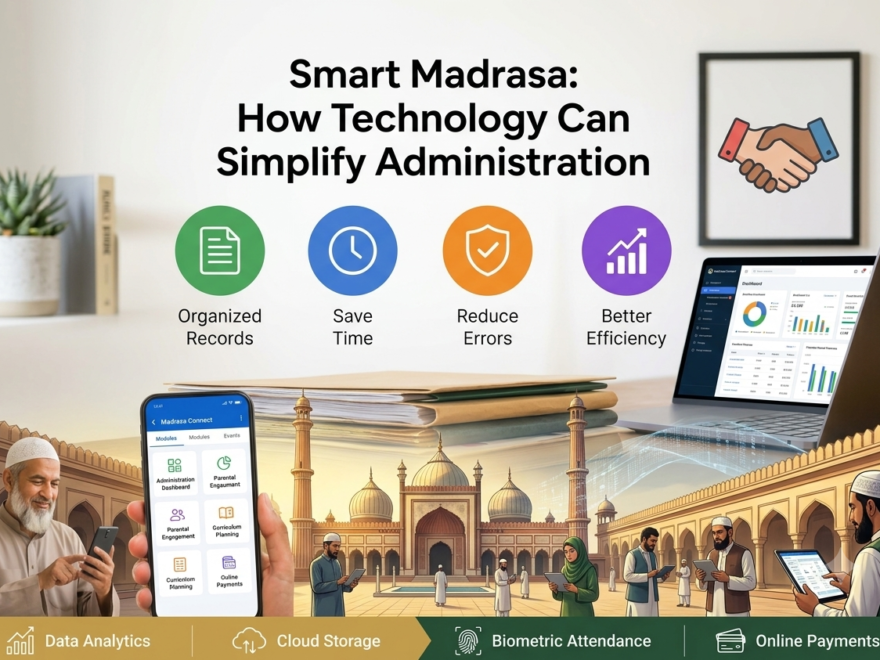
A Smart Madrasa is a modern approach to madrasa administration that combines traditional Islamic education with digital technology. By using Madrasa Management Software, institutions can simplify daily administrative tasks, organize student information, manage attendance and fees, monitor academic performance, and improve communication with parents.
Traditional madrasa administration often depends on registers, notebooks, spreadsheets, and manual record keeping. While these methods can work for smaller institutions, managing large numbers of students and multiple classes can become difficult.
A Smart Madrasa uses a centralized digital system to manage important information and daily activities from one platform.
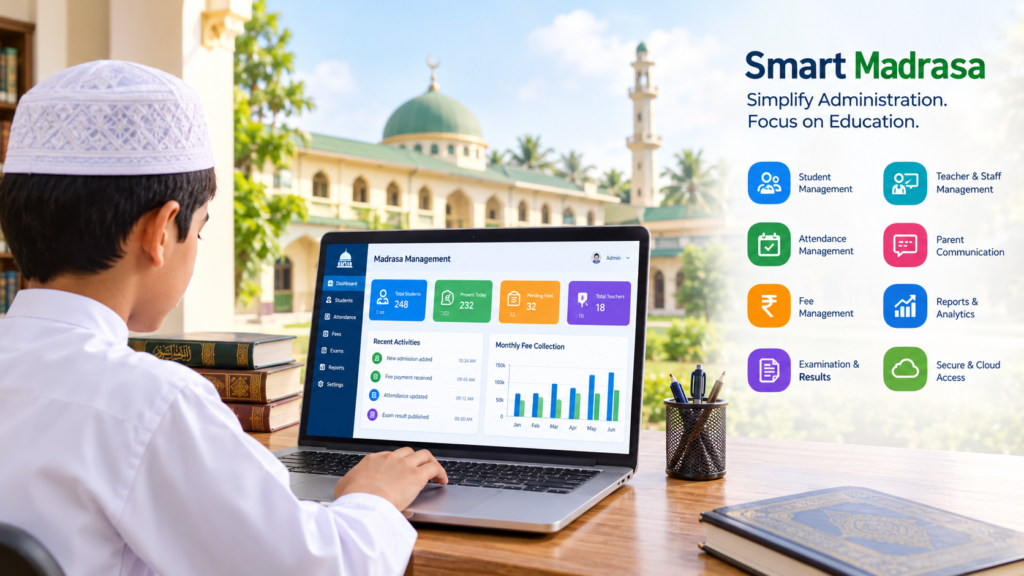
Depending on the software, a digital madrasa management system can help manage:
- Student registration
- Student profiles
- Teacher information
- Class and division management
- Attendance
- Fee collection
- Examination and results
- Academic performance
- Parent communication
- Notifications
- Reports
- Staff management
- Academic schedules
- Digital records
This makes it easier for madrasa administrators to access the information they need whenever required.
Why Do Madrasas Need Digital Management?
Madrasa administrators often have to handle many responsibilities simultaneously. Maintaining student records, collecting fees, monitoring attendance, organizing examinations, communicating with parents, and preparing reports can require considerable time.
Manual administration can also create challenges such as:
- Lost or damaged records
- Duplicate data entry
- Difficulty finding old information
- Calculation errors
- Time-consuming report preparation
- Attendance tracking difficulties
- Delayed communication
- Difficulty monitoring student performance
Digital management can address many of these challenges by keeping information organized in a centralized system.
How Technology Simplifies Madrasa Administration
1. Centralized Student Management
A madrasa management system can maintain complete student profiles in one place.
Administrators can store information such as:
- Student name
- Admission number
- Date of birth
- Address
- Parent or guardian details
- Contact information
- Class
- Division
- Academic records
- Attendance history
- Fee information
Instead of searching through multiple registers, authorized staff can quickly find a student’s information through the software.
This can make student administration faster and more organized.
2. Easy Student Admission
Student admission is an important administrative activity every academic year.
With a digital admission system, staff can enter student information directly into the software and create a student profile.
The system can help organize admission information and reduce repetitive paperwork.
Digital admission records can also make it easier to search and retrieve student information later.
3. Digital Attendance Management
Attendance is one of the most frequently performed tasks in a madrasa.
Traditional attendance registers require teachers to manually record attendance and administrators may later need to calculate attendance percentages.
With digital attendance management, teachers can record attendance through the system.
Administrators can then view:
- Daily attendance
- Monthly attendance
- Class-wise attendance
- Student-wise attendance
- Attendance percentage
- Absence records
This reduces manual calculations and provides a clearer overview of student attendance.
4. Simplified Fee Management
Managing madrasa fees manually can become complicated when there are many students and different fee structures.
A digital fee management module can help administrators maintain payment records and track pending amounts.
The system can provide information such as:
- Paid fees
- Pending fees
- Payment history
- Student-wise fee records
- Class-wise collections
- Monthly collection reports
Digital records can also reduce the possibility of misplaced receipts or incorrect calculations.
5. Examination and Result Management
Examinations are an important part of academic administration.
Instead of maintaining separate mark registers and manually preparing result sheets, madrasa administrators can use digital examination management.
A software system can help manage:
- Exam names
- Subjects
- Marks
- Grades
- Student results
- Class-wise performance
- Result reports
Teachers can enter marks, while administrators can generate reports from the stored data.
This can make result preparation more organized and reduce repetitive work.
6. Better Student Performance Tracking
A Smart Madrasa can provide a more complete view of student progress.
By combining attendance, examination results, and academic information, administrators and teachers can identify students who may need additional attention.
For example, a student with consistently low attendance and declining examination performance may require additional support or communication with parents.
Digital records make it easier to monitor such patterns over time.
7. Teacher and Staff Management
Madrasa management is not only about students.
A digital system can also maintain teacher and staff information, including:
- Teacher profiles
- Assigned classes
- Subjects
- Attendance
- Responsibilities
- Contact information
A centralized staff management system can help administrators organize responsibilities more effectively.
8. Parent Communication
Communication between the madrasa and parents is an important part of education.
Digital systems can help madrasas communicate important information through notifications, SMS, WhatsApp integrations, mobile applications, or other supported communication channels.
Depending on the system, parents may receive information regarding:
- Attendance
- Fee reminders
- Examination information
- Results
- Announcements
- Events
- Important notices
Better communication can help parents stay informed about their child’s madrasa activities.
9. Automated Reports
Preparing reports manually can take significant administrative time.
A madrasa management system can generate different reports from the information already stored in the system.
Examples include:
- Student reports
- Attendance reports
- Fee collection reports
- Pending fee reports
- Examination reports
- Class-wise reports
- Teacher reports
- Admission reports
Automated reports can help administrators make better use of their time and reduce repetitive administrative work.
10. Reduced Paperwork
One of the major advantages of digital administration is reducing dependence on paper records.
Instead of maintaining multiple registers for different activities, information can be stored digitally.
This can help reduce:
- Paper usage
- Storage requirements
- Manual record keeping
- Repetitive data entry
- Physical document searching
Digital records can also make historical information easier to retrieve when required.
Smart Madrasa for Multiple Branches
Some educational organizations manage multiple madrasa branches.
Managing several branches using separate registers and spreadsheets can become increasingly difficult.
A centralized madrasa management platform can allow administrators to manage multiple branches from one system, depending on the software architecture.
Administrators may be able to monitor:
- Branch-wise student numbers
- Attendance
- Fee collections
- Examination results
- Teachers
- Classes
- Reports
This provides a broader view of the organization while allowing individual branches to manage their daily activities.
Data Security and Access Control
Student and institutional information should be handled carefully.
A digital madrasa management system can use user accounts and role-based access to control who can access different types of information.
For example:
- Administrator – Full system access
- Principal/Head – Academic and administrative access
- Teacher – Assigned class and student information
- Accountant – Fee and payment information
- Staff – Specific operational access
Proper access control can help prevent unauthorized users from accessing sensitive information.
Regular backups are also important to protect important digital records from accidental loss.
Mobile-Friendly Madrasa Management
Modern software should work across different devices.
A responsive or mobile-friendly madrasa management system can allow administrators and teachers to access important information from:
- Desktop computers
- Laptops
- Tablets
- Smartphones
This is particularly useful for teachers who may need to record attendance or access student information while away from the main office.
Saving Time Through Automation
The biggest advantage of technology is not simply storing information digitally. It is the ability to automate repetitive administrative tasks.
For example, instead of manually calculating attendance percentages, preparing fee-pending lists, and compiling examination results, software can process stored information automatically.
This allows administrators and teachers to spend more time on educational and student-focused activities.
Traditional Administration vs Smart Madrasa
| Traditional Administration | Smart Madrasa |
|---|---|
| Paper-based records | Digital records |
| Manual attendance | Digital attendance |
| Manual fee tracking | Automated fee records |
| Separate registers | Centralized database |
| Manual report preparation | Automated reports |
| Difficult data searching | Quick information search |
| Limited communication | Digital notifications |
| More paperwork | Reduced paperwork |
| Manual calculations | Automated calculations |
| Physical storage | Digital storage |
The objective of digital transformation is not necessarily to replace traditional madrasa education. Instead, technology can support administrators and teachers by making administrative processes more efficient.
How to Start the Digital Transformation
A madrasa does not necessarily need to digitize every process at once.
A practical approach is to begin with essential areas such as:
- Student management
- Teacher management
- Attendance
- Fee management
- Examination and results
- Parent communication
- Reports
Once the basic system is established, additional features can be introduced based on the madrasa’s requirements.
Before selecting a software solution, administrators should consider factors such as ease of use, scalability, security, mobile compatibility, reporting capabilities, support, and the ability to customize the system according to their madrasa’s workflow.
Benefits for Administrators, Teachers and Parents
For Administrators
- Centralized information
- Faster administrative work
- Easier report generation
- Better financial tracking
- Reduced paperwork
- Improved record management
For Teachers
- Easy attendance management
- Quick access to student information
- Simplified mark entry
- Better performance tracking
- Reduced administrative workload
For Parents
- Better communication
- Access to attendance information
- Fee reminders
- Examination updates
- Improved visibility of student progress
For Students
- Better organized academic records
- Improved monitoring of attendance
- Easier access to academic information
- More efficient administrative processes
The Future of Smart Madrasa Management
The digital transformation of education is continuing to evolve. In the future, madrasa management systems may increasingly incorporate features such as mobile applications, online learning, automated notifications, advanced analytics, digital certificates, online payments, and intelligent reporting.
However, technology should remain a tool that supports the educational mission of the madrasa.
The core purpose of a madrasa remains education, character development, discipline, and the transmission of knowledge. Digital tools can help reduce administrative burdens so that educators and administrators can focus more effectively on these core responsibilities.
Conclusion
A Smart Madrasa is more than a madrasa that uses computers. It represents a more organized approach to managing students, teachers, attendance, fees, examinations, communication, and administrative information.
With the right Madrasa Management Software, institutions can reduce paperwork, improve record accuracy, simplify daily tasks, and provide better communication between administrators, teachers, students, and parents.
Technology cannot replace the role of teachers or the educational values of a madrasa. Instead, it can provide the digital infrastructure needed to manage modern educational administration more efficiently.
For madrasas looking to modernize their administration while maintaining their educational traditions, adopting a reliable digital management system can be an important step toward becoming a truly Smart Madrasa.
Frequently Asked Questions
What is Smart Madrasa?
Smart Madrasa refers to a madrasa that uses digital technology and management software to organize administrative and academic activities such as student management, attendance, fees, examinations, communication, and reporting.
What is Madrasa Management Software?
Madrasa Management Software is a digital platform designed to help manage the administrative and academic activities of a madrasa from a centralized system.
Can Madrasa Management Software manage student attendance?
Yes. Depending on the software, teachers can record daily attendance and administrators can generate student-wise, class-wise, and monthly attendance reports.
Can the software manage madrasa fees?
Yes. Fee management features can help record payments, monitor pending fees, maintain payment history, and generate collection reports.
Can parents receive notifications?
Many modern madrasa management systems support parent communication through notifications, SMS, WhatsApp, email, or mobile applications, depending on the available integrations.
Is Smart Madrasa suitable for small madrasas?
Yes. A properly designed system can be scaled according to the size and requirements of the institution, from a small madrasa to organizations with multiple branches.
Why should a madrasa move from manual records to digital management?
Digital management can make information easier to access, reduce repetitive paperwork, simplify reporting, improve record organization, and help administrators manage daily activities more efficiently.
Get in Touch
Interested in Madrasa Software? Contact us today to schedule your free demo!