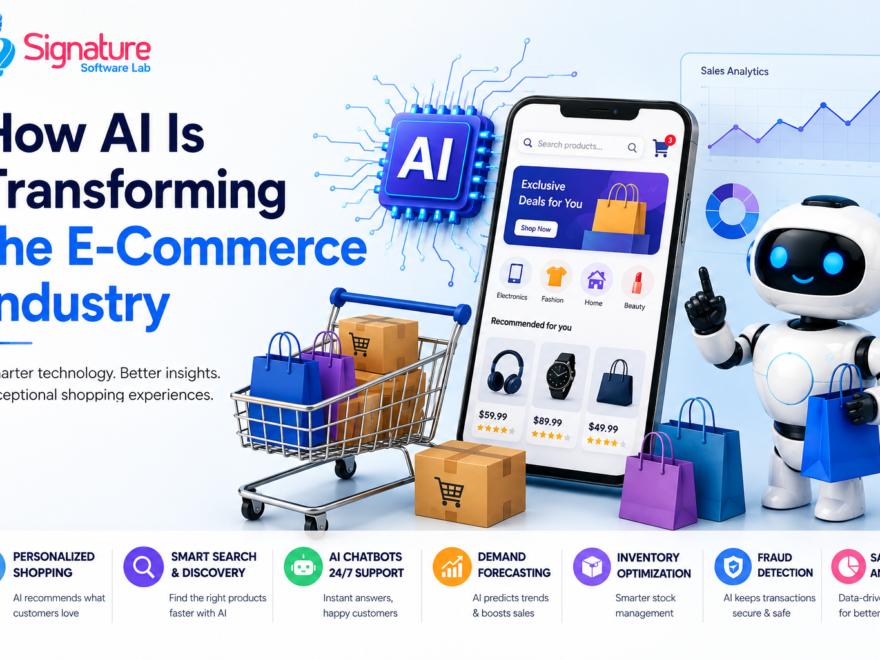
Artificial Intelligence (AI) is rapidly changing the way e-commerce businesses attract customers, recommend products, manage operations, and increase sales. In 2026, simply having an online store is no longer enough. Businesses are increasingly looking for AI-powered e-commerce software that can understand customer behavior, automate repetitive tasks, personalize shopping experiences, and support smarter business decisions.
Whether you are planning to build a new e-commerce platform or upgrade an existing system, integrating the right AI features can give your business a significant competitive advantage.
Here are some of the most important AI features to build into e-commerce software in 2026.
Table of Contents
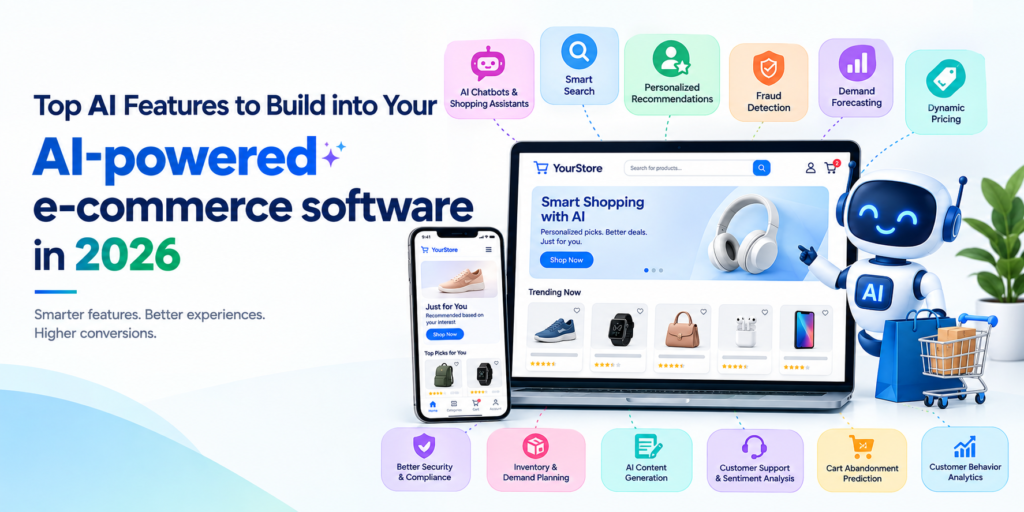
1. AI-Powered Product Recommendations
Product recommendations are one of the most valuable applications of AI-powered e-commerce software.
Instead of showing the same products to every visitor, an AI-powered recommendation engine can analyze browsing history, previous purchases, search behavior, product preferences, and similar customer activity.
For example, if a customer purchases a smartphone, the system can automatically recommend compatible cases, screen protectors, chargers, or headphones.
AI can provide recommendations such as:
- Frequently bought together products
- Similar products
- Recently viewed products
- Personalized product suggestions
- Products based on previous purchases
- Trending products for individual customers
This creates a more personalized shopping experience while increasing opportunities for cross-selling and upselling.
2. AI Chatbots and Shopping Assistants
AI-powered chatbots are becoming an important part of modern AI-powered e-commerce software platforms.
Customers often have questions about products, pricing, availability, delivery, returns, payment methods, and order status. An AI shopping assistant can provide instant answers without requiring a customer-support employee to handle every request.
An advanced AI chatbot can also help customers discover products.
For example, a customer could ask:
“I need a laptop for video editing under ₹80,000.”
The AI assistant can understand the requirement and suggest suitable products based on price, specifications, availability, and customer preferences.
3. Personalized Shopping Experience
Every customer has different interests and purchasing behavior. AI-powered e-commerce software can use customer data to create a personalized shopping experience for each visitor.
The platform can dynamically personalize:
- Homepage product displays
- Product recommendations
- Search results
- Promotional offers
- Email campaigns
- Discounts
- Content
- Notifications
For example, two customers visiting the same e-commerce website may see different product recommendations based on their previous interactions.
Personalization can help businesses improve engagement, conversion rates, and customer retention.
4. AI-Powered Smart Search
Traditional e-commerce search systems often depend heavily on exact keywords. AI-powered search can understand the customer’s intent rather than simply matching words.
For example, instead of searching for “black running shoes men,” a customer could type:
“Show me comfortable black shoes for running under ₹5,000.”
An AI-powered search system can understand product category, color, purpose, price range, and other requirements.
AI search can also handle spelling mistakes, natural language queries, synonyms, and conversational searches, making it easier for customers to find what they need.
5. AI-Based Product Description Generation
Creating product descriptions for hundreds or thousands of products can be time-consuming.
AI can help AI-powered e-commerce software businesses automatically generate product descriptions based on product specifications, features, categories, and other information.
For example, the system can generate:
- Product titles
- Short descriptions
- Detailed descriptions
- Product highlights
- SEO descriptions
- Meta titles
- Meta descriptions
- Product FAQs
Businesses can then review and edit the AI-generated content before publishing it.
This can significantly reduce the time required to manage large product catalogs.
6. AI Image and Visual Search
Visual search allows customers to search for products using images instead of text.
For example, a customer can upload a picture of a handbag, shoe, dress, or piece of furniture. AI can analyze the image and find visually similar products available in the store.
AI-powered image technology can also help businesses with:
- Product image classification
- Automatic background removal
- Image tagging
- Similar product discovery
- Visual product matching
- Image quality analysis
Visual search can be especially useful for fashion, furniture, accessories, and lifestyle e-commerce platforms.
7. AI-Powered Fraud Detection
AI-powered e-commerce software businesses need strong security systems to detect suspicious transactions.
AI can analyze transaction patterns and identify unusual behavior in real time. It can consider factors such as purchasing behavior, payment patterns, device information, location signals, and unusual order activity.
The system can assign risk scores to transactions and flag suspicious orders for manual review.
AI-based fraud detection can help reduce:
- Payment fraud
- Fake accounts
- Suspicious orders
- Account abuse
- Coupon abuse
- Promotional fraud
The exact implementation should also respect applicable privacy, security, and financial regulations.
8. AI Inventory and Demand Forecasting
Managing inventory is one of the biggest challenges in e-commerce.
Too much inventory can increase storage costs, while insufficient stock can result in lost sales.
AI can analyze historical sales, seasonal patterns, customer demand, promotions, and other business data to forecast future product demand.
For example, an AI-powered e-commerce software system may identify that demand for a particular product regularly increases during a specific season and help the business plan inventory accordingly.
AI-based forecasting can support:
- Stock planning
- Reordering
- Demand prediction
- Seasonal inventory management
- Overstock reduction
- Out-of-stock prevention
9. AI Dynamic Pricing
AI can also help businesses make smarter pricing decisions.
A dynamic pricing system can analyze factors such as demand, inventory levels, competitor pricing, seasonal trends, and sales performance to provide pricing recommendations.
For example, if AI-powered e-commerce software demand for a product increases while inventory becomes limited, the system can alert the business that pricing should be reviewed.
Businesses should implement dynamic pricing carefully and transparently, particularly where consumer-protection or pricing regulations apply.
10. AI Customer Behavior Analytics
AI can turn large amounts of e-commerce data into AI-powered e-commerce software.
Instead of simply displaying reports, an AI analytics system can identify patterns and explain what may be happening.
For example:
“Customers are frequently viewing this product but leaving the checkout page. Similar products with lower delivery charges have a higher conversion rate.”
AI can analyze:
- Customer journeys
- Cart abandonment
- Conversion rates
- Product performance
- Customer segments
- Purchase patterns
- Marketing performance
These insights can help businesses make data-driven decisions.
11. AI Cart Abandonment Prediction
Cart abandonment is a major challenge for online stores.
AI-powered e-commerce software can analyze customer behavior and identify customers who are more likely to abandon their carts. The platform can then trigger suitable actions, such as reminders, personalized recommendations, or targeted offers.
For example, an e-commerce platform could automatically send a reminder to a customer who added products to their cart but did not complete the purchase.
The goal is not simply to send more notifications, but to send relevant messages at the appropriate time.
12. AI-Based Customer Support and Sentiment Analysis
AI-powered e-commerce software can analyze customer reviews, support messages, and feedback to identify common issues and customer sentiment.
It can categorize feedback as positive, negative, or neutral and identify recurring topics such as:
- Product quality
- Delivery delays
- Packaging
- Customer service
- Returns
- Pricing
This gives businesses a clearer understanding of customer expectations and helps them identify areas that need improvement.
Conclusion
AI-powered e-commerce software is becoming an essential component of modern e-commerce software. From personalized recommendations and intelligent search to fraud detection, demand forecasting, automated content creation, and AI customer support, these technologies can improve both the customer experience and business efficiency.
However, businesses should not add AI-powered e-commerce software features simply because they are trending. The best approach is to identify specific business problems and implement AI where it can provide measurable value.
In 2026, a successful
AI-powered e-commerce software
should combine personalization, automation, intelligent analytics, security, and seamless customer experiences.If you are planning to build or upgrade an e-commerce platform, integrating the right AI capabilities from the beginning can create a smarter, more scalable, and future-ready solution.
📞 Get Your FREE Consultation Today!
Start your e-commerce journey with a reliable software development partner. Our experts are ready to discuss your project and recommend the best solution for your business.