Madrasa Management Software
Managing a madrasa involves much more than teaching students. Administrators and teachers need to handle student admissions, attendance, fees, examinations, teacher records, communication, and many other daily activities. Managing all these tasks manually can be time-consuming and may lead to errors.
Madrasa Management Software provides a simple and efficient way to digitise and manage these activities from a centralised platform. It helps madrasas reduce administrative workload, improve accuracy, and provide better services to students, parents, teachers, and administrators.
What Is Madrasa Management Software?
Madrasa Management Software is a digital solution designed to manage the day-to-day operations of a madrasa. It can bring different administrative and academic activities together in one system.
Depending on the software, it may include modules for:
- Student admission and registration
- Student profile management
- Attendance management
- Class and batch management
- Teacher and staff management
- Fee collection and payment tracking
- Examination and result management
- Parent communication
- SMS and notifications
- Reports and analytics
- Certificate management
- User and access management
By moving from paper-based processes to a digital system, madrasas can manage their operations more efficiently.
Top Benefits of Madrasa Management Software
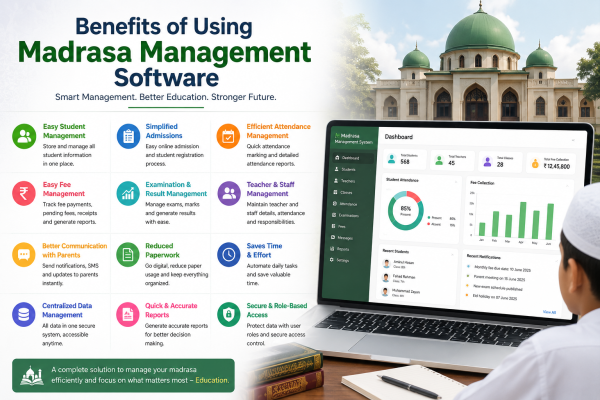
1. Easy Student Management
Managing hundreds of student records manually can be difficult. Madrasa management software allows administrators to store student information in a centralized database.
Details such as student name, contact information, admission details, class, guardian information, attendance, fees, and academic records can be maintained in one place.
This makes it easier to search, update, and access student information whenever required.
2. Simplified Student Admission
The admission process can be made faster and more organized with digital registration.
Administrators can enter student details, assign classes, maintain admission records, and generate required documents without depending entirely on paper files.
A structured admission system also helps reduce duplicate or missing information.
3. Accurate Attendance Management
Attendance is an important part of student management. Recording attendance manually every day can take considerable time.
With digital attendance management, teachers or authorized staff can record student attendance quickly and maintain historical attendance records.
Administrators can also generate attendance reports to identify attendance patterns and follow up when necessary.
4. Efficient Fee Management
Managing madrasa fees manually can become challenging, especially when there are many students and different fee structures.
Madrasa management software can help administrators:
- Record fee payments
- Track pending payments
- Generate receipts
- Maintain payment history
- Monitor outstanding amounts
- Generate financial reports
This provides better control over fee collection and reduces the possibility of calculation or recording errors.
5. Better Examination and Result Management
Managing examinations, marks, grades, and student results can be simplified through a digital system.
Teachers or administrators can enter marks and generate result reports based on the configured examination structure.
Instead of preparing results manually, the software can help organize academic performance records and make them easier to access.
6. Improved Teacher and Staff Management
A madrasa management system can also help maintain teacher and staff information in one place.
Administrators can manage details such as:
- Teacher profiles
- Assigned classes
- Subjects or courses
- Attendance
- Responsibilities
- Staff records
This makes staff administration more organized and reduces paperwork.
7. Better Communication with Parents
Communication between the madrasa and parents is essential.
A management system can help send important updates and notifications regarding attendance, fees, examinations, events, holidays, and other announcements.
Depending on the system, communication can be provided through SMS, email, mobile applications, or parent portals.
8. Saves Time and Reduces Paperwork
One of the biggest advantages of digital management is reduced administrative work.
Tasks that previously required maintaining registers, searching through files, calculating fees, preparing reports, and updating multiple records can be handled through a centralized system.
This allows administrators and teachers to spend more time focusing on students and educational activities.
9. Centralized Data Management
Instead of maintaining separate registers and spreadsheets, madrasa information can be stored in one centralized system.
This makes it easier for authorized users to access the information they need while maintaining better organization.
Centralized data also makes reporting and record management much easier.
10. Easy Report Generation
Reports help administrators understand how the madrasa is performing.
Management software can generate different types of reports, such as:
- Student reports
- Attendance reports
- Fee collection reports
- Pending fee reports
- Examination reports
- Teacher reports
- Admission reports
- Class-wise reports
These reports can help management make informed decisions and monitor daily operations.
11. Improved Data Accuracy
Manual data entry and calculations can result in mistakes. A digital management system can reduce many common administrative errors by maintaining structured records and automating calculations.
Accurate information is especially important for student records, attendance, fees, and examination results.
12. Secure Access to Information
A properly designed madrasa management system can provide user-based access to information.
For example, administrators, teachers, accountants, and other staff members can be given different permissions according to their responsibilities.
This helps protect important information and ensures that users only access the features and data relevant to their roles.
13. Access Information More Easily
With a web-based or cloud-based system, authorized users can access information from different devices and locations, depending on the software’s setup.
This can be particularly useful for madrasa administrators who need to monitor activities without being physically present at their desk.
14. Supports Digital Transformation
Many educational institutions are moving from traditional paper-based processes to digital management.
Implementing madrasa management software is an important step toward modernizing administrative operations. It helps institutions become more organized, efficient, and prepared for future digital requirements.
Who Can Benefit from Madrasa Management Software?
Madrasa management software can be useful for:
- Small madrasas
- Large madrasas
- Islamic educational institutions
- Weekend madrasas
- Multiple-branch madrasas
- Religious education centers
- Quran learning institutions
The required features may vary depending on the size and operational structure of each institution.
Conclusion
Madrasa management software can significantly simplify the daily administration of an educational institution. From student admissions and attendance to fees, examinations, teacher management, communication, and reporting, a digital system can bring important activities together in one place.
By reducing paperwork, improving data accuracy, saving time, and providing better access to information, madrasa management software helps administrators and teachers focus more on their primary goal — providing quality education and better support to students.
If your madrasa is still relying on registers, spreadsheets, or multiple disconnected systems, moving to a dedicated Madrasa Management Software can be an effective step toward more efficient and organised management.
Try Our Software Demo
Link : Click here
Username: admin
Password: 123456